
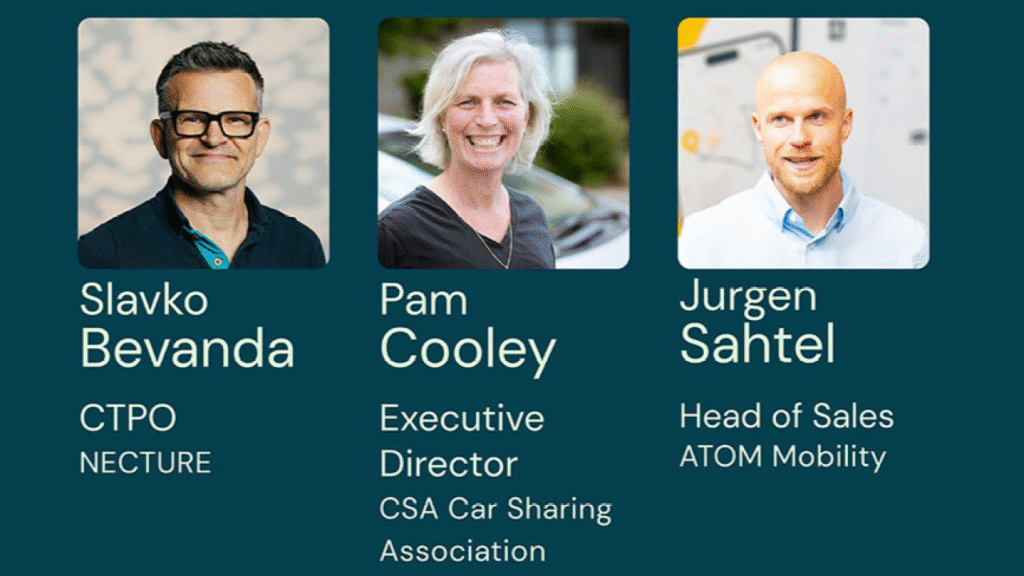
Webinar: Cars on Demand 2.0: Data, Digitalization, and the Principles That Make Carsharing Work
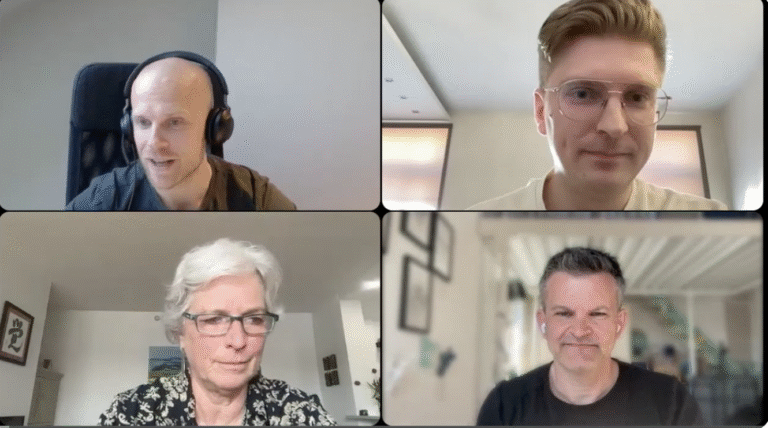
Earlier this month, the CSA joined Necture and ATOM Mobility for a live webinar exploring how the shared mobility landscape is evolving — and what it takes to build carsharing operations that actually last. Three speakers brought very different vantage points to the conversation: market data from the sales floor, intelligence from the data layer, and hard-won lessons from the ground up.
The line between carsharing and car rental is disappearing
Jürgen Sahtel, Head of Sales at ATOM Mobility, opened with a question his team hears constantly: are you looking for carsharing software, or car rental software? Increasingly, the answer is both — or neither, exactly.
ATOM has logged 544 qualified conversations with carsharing and rental operators across 86 countries over the past two years. A year ago, that split was roughly 70% carsharing leads to 30% rental. Today it’s 50/50. Traditional rental companies are feeling the pressure from carsharing operators and are actively looking to digitalize their customer experience. At the same time, carsharing operators are exploring longer-term, calendar-based rental functionality to capture more use cases.
The convergence is showing up in the apps people actually use. Free2Move now offers station-based carsharing alongside multi-day rentals, all with keyless access. Bolt has introduced day-rate pricing for longer trips directly alongside its on-demand offering. Hertz launched its own carsharing app. The gap between “I need a car in the next ten minutes” and “I need a car for the weekend” is closing — and the operators building for both are setting the pace.
What’s holding others back? According to Jürgen, 72% of the leads ATOM spoke with weren’t ready to move forward — not because the interest wasn’t there, but because the operational and mindset shift felt too risky. Many local rental operators don’t yet feel competitive pressure from carsharing, and they’re reluctant to change workflows that are working well enough. The change is coming regardless. The question is whether operators get ahead of it or react to it.
Data isn't an IT topic — it's a revenue engine
Slavko Bevanda, CTPO at Necture, picked up from there with a look at what the next phase of mobility operations actually requires: not just collecting data, but knowing what to do with it.
The numbers are striking. By 2030, more than 90% of vehicles sold will be connected, generating over 25 gigabytes of data per vehicle per hour. The opportunity isn’t in having access to that data — it’s in structuring it and acting on it in real time.
Slavko framed this around three pillars:
- Revenue maximization. Predictive fleet simulation, dynamic pricing, and the ability to flip assets between B2B and B2C in real time — all of this becomes possible when operators can see not just where their cars are, but where demand is going to be before it happens. Necture works with a street crowd community of roughly 25,000 people across more than 15 cities to support proactive vehicle relocation — moving cars to where they’ll be needed, not where they happen to be sitting.
- Operational efficiency. Condition-based maintenance, predictive charging scheduled to minimize downtime, data-driven rebalancing — these reduce idle time and keep more vehicles earning.
- Safety and risk. Driver scoring, smoke detection, damage detection — all GDPR-compliant, and all increasingly expected by operators managing fleets at scale.
The shift Slavko described is one that anyone who’s been in this industry a while will recognize: we’ve moved from “where is my car?” to “how is my car performing, and what should I do about it right now?” The operators who build that intelligence into their decision-making will be the ones who scale. Those who don’t will find that running a robotaxi fleet — when that era arrives — is even harder than running a carsharing fleet today.
Technology is necessary. It isn't sufficient.
CSA Executive Director Pam Cooley brought the conversation back to earth — and it was the part of the webinar the audience responded to most.
Pam started her own carsharing company in Halifax, Nova Scotia in 2008, sold it to Communauto in 2019, and has spent the years since working with carsharing operators all over the world through the CSA. Her perspective is one that’s hard to get anywhere else: she’s seen what works, what fails, and what the failure costs everyone else in the industry when a high-profile operator exits a market.
Her central point: carsharing is not just a mobility product. It’s the only mode that demonstrably reduces personal vehicle ownership, eases congestion, and integrates into a transit-oriented city system. That matters — not just as a values statement, but as a strategic reality. Cities are your partners. Without them, nothing else works.
Zipcar‘s withdrawal from London was the example she pointed to. Without consistent parking regulation across boroughs, expansion becomes impossible. When an operator pulls out, it’s not the company that takes the reputational hit — it’s carsharing as a concept. Every operator left in the market absorbs some of that damage.
The caution Pam offered wasn’t anti-technology. She’s enthusiastic about data, about keyless access, about the tools that make operations leaner. But she asked the questions that sometimes get lost in the excitement: Who are we serving? What are we measuring, and for whom? City regulators need different data than fleet operators. Community members need different things than tech investors. Getting those relationships right — with cities, with residents, with regulators — is not a soft skill. It’s a prerequisite for operating at all.
Her advice for anyone entering or expanding in carsharing: do your stakeholder work. Don’t just build the technology stack. Build the relationships that make the parking possible.
What the Q&A surfaced
The audience questions covered a lot of ground — connectivity in rural areas, finding parking partners, vehicle theft prevention, keeping fleets clean across different user cultures, and rebalancing at scale. A few things that came up worth noting:
- On connectivity gaps: IoT access doesn’t have to depend on a live cellular connection. Operators can use Bluetooth or SMS commands as a fallback, and vehicles can still be driven normally outside coverage areas — the car just needs to be connected when it’s in range to sync up.
- On parking: The technology for helping drivers find permitted spots exists and is already integrated into many carsharing apps. The harder problem is securing those spots in the first place, which comes back to city relationships.
- On vehicle tidiness: It varies by geography and by fleet size. Cameras have become a useful tool — not just for operators, but for members who want to protect themselves from being blamed for damage they didn’t cause. Community norms matter too; the best operators actively build a sense of shared responsibility among their members.
- On rebalancing at scale: Dynamic pricing to steer customer behaviour, combined with a crowd-based relocation model, is how Necture approaches this. No single solution works everywhere — it depends on city density, fleet size, and the operator’s existing infrastructure.
The Carsharing Association unites carshare operators, mobility partners, cities, micromobility providers, and public authorities to grow the ecosystem together. If you’re not yet a member, explore the operator, mobility partner, and city/public authority membership options.
If you’re planning ahead, pencil in our in-person gathering next fall in Vancouver—and keep an eye out for upcoming webinars you can share with your teams and networks.
Join the CSA in Vancouver this October
The CSA‘s annual conference is happening October 5–6, 2026 at the Pinnacle Hotel at the Pier in North Vancouver — a city with one of the most developed carsharing ecosystems in North America, home to operators like Modo and Evo.
This year’s theme is Carsharing at the Core, and the conversations from this webinar — city partnerships, data intelligence, the convergence of rental and sharing models — are exactly the kind of ground we’ll be covering. It’s a carsharing-specific event, not a broad mobility conference, which means the people in the room are the people doing this work.
Early bird tickets are available now here.
If you’re a carsharing operator, part of the ecosystem, or thinking about entering the market — we’d love to see you there.