
Stranded in Yosemite
A guest article from INVERS, drawn from a conversation with KINTO Mobility, Toyota's carsharing brand, during the industry webinar "Growing and Scaling Carsharing Fleets," featuring Jimmy Ouyang (former National Manager) and Jason Zahorik (former Group Manager) of KINTO Mobility.
It started as one rental, one weekend, a trip to Yosemite. A KINTO customer booked a car through the app, drove out past cell coverage for a few days, and settled in. When it came time to leave, the vehicle wouldn't unlock. No signal, no access, no way home.
What followed, KINTO's Jimmy Ouyang recalled, was an all-hands rescue mission. The team arranged a tow truck and a plane ticket home. The fallout showed up soon after in a review that read exactly like the incident: stranded, no access, don't bother.
It wasn't an isolated event. By the summer of 2021, KINTO's growth had gone flat. Not because demand dried up, but because the team spent too much time elsewhere to take on new customers.
When Firefighting Becomes the Job
Kinto faced significant hurdles with telematics hardware from its initial technology partners, which posed a serious risk to its rapid expansion and could have tarnished its parent company's esteemed reputation.
Vehicle installation processes proved particularly problematic. Installations that were supposed to take thirty minutes usually didn't. "It's a 30-minute install if things work correctly," Jason Zahorik said. "But then when things don't, it becomes a couple-of-days event where you're just constantly troubleshooting and trying to get to the bottom of what's going on."
These installations were not only time-consuming but also error-prone, often requiring multiple visits to a single vehicle and delays because of time zone differences with the support team.
Reliability issues further compounded the challenges. KINTO's early telematics hardware exhibited a disturbingly high failure rate, with devices frequently arriving non-functional or failing during operation. The devices were also susceptible to disconnecting after minor vehicular shocks, such as speed bumps or potholes. Even more troubling, the hardware had a tendency to drain car batteries during long parking stretches, but they were poorly designed that a routine jump-start could fry the unit, turning a simple roadside fix into another vehicle knocked offline.
Support challenges were equally daunting. The team grappled with delayed responses due to the asynchronous communication inherent with an overseas support team. At times, external system technicians deflected responsibility, advising, "It's not our fault. Talk to your software provider," which further muddled issue resolution and prolonged downtime.
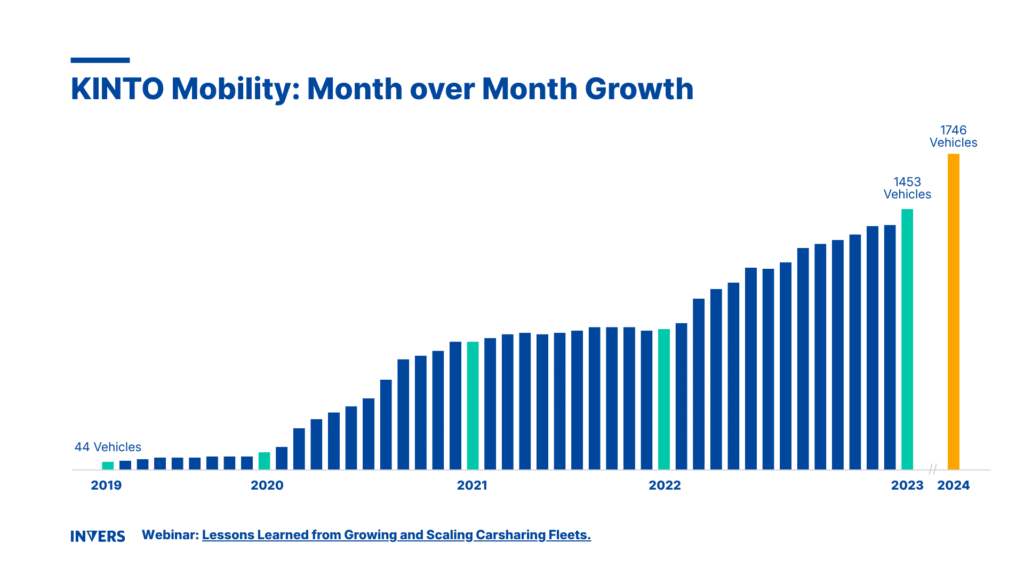
These accumulated issues brought Kinto's fleet expansion to a near standstill by summer 2021, with growth remaining stagnant over the next year. The mounting operational difficulties not only caused sleep deprivation among call center staff but were also eroded customer satisfaction and retention.
Recognizing the unsustainable nature of these challenges, Jimmy and Jason were compelled to reconsider their strategy. They knew that without addressing these foundational issues, any further scaling efforts would only amplify the chaos and make the situation unmanageable.
"To be honest, we didn't know how drastic the difference would be until we actually switched."
KINTO wasn't the only one. When we polled the audience during the webinar on how much time their team spends on IoT and telematics issues, half couldn't put a number on it. The most common answer was a shrug: "I don't know, but we talk about it at every meeting." Among those who could put a number on it, most were roughly 10%.
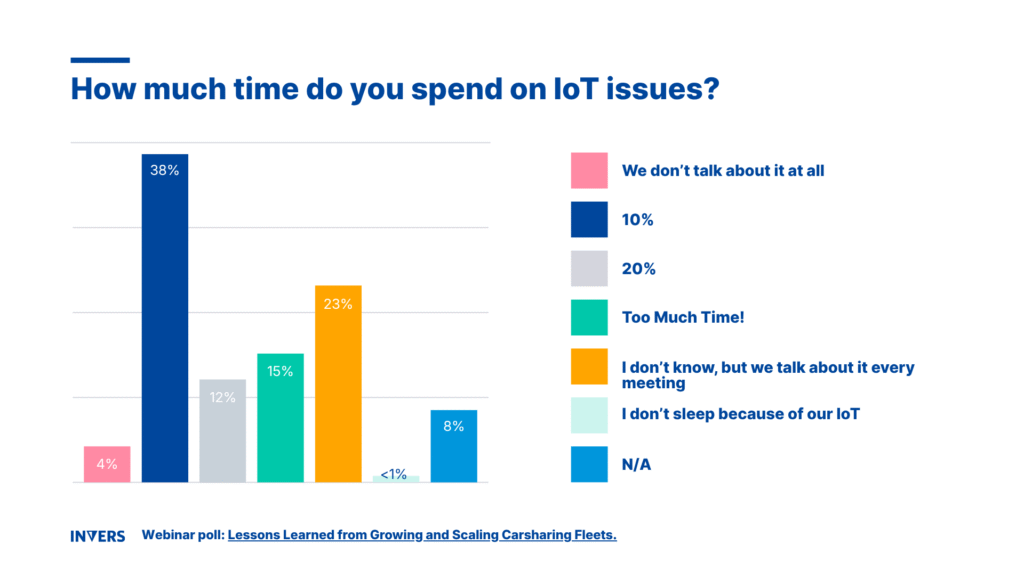
That's the real lesson underneath KINTO's story, and it's worth sitting with. Most operators don't have a control group. You don't get to run your fleet twice, once with bad telematics and once without, and compare notes. So the baseline for "normal" ends up being whatever you're currently living through: support calls at all hours, bad reviews you've learned to expect, a growth chart that's gone flat while everyone's too busy to ask why.
The Cost of Switching
Jason was candid that recognizing the problem was the easy part. Acting on it was harder. Re-equipping a fleet the size of KINTO's meant retraining installers and support staff, and admitting that a decision that had already absorbed real money (hundreds of thousands of dollars) hadn't worked out. That's a hit to the ego, and it's the reason so many operators wait for one more patch instead of making the call.
Chris Anderson, INVERS Sales Director who worked with KINTO through the transition, put a name to the pattern: providers in real trouble rarely fail all at once. They fail one patch at a time, and the most recent fix is never the last.
When KINTO went looking for a replacement, they didn't rely on vendor pitches alone. Paul Hirsch, CEO of Launch Mobility, KINTO's software partner, was blunt about why INVERS stood out: "As KINTO expanded their shared fleet, they needed a telematics partner that could deliver reliability across thousands of units. INVERS has a long track record of success with large fleets." Toyota's own innovation team had independently been testing INVERS hardware. Two outside signals pointing the same direction are a better evaluation method than a demo.
What Actually Changed
After launching in 2019, KINTO's fleet expansion stalled by summer 2022 as the team fought through hardware challenges. Then in 2022, the team replaced the existing technology on its entire 800-car fleet with INVERS CloudBoxx. The team grew the fleet 85% to 1,453 vehicles in 2023, and to 1,746 by March 2024, constrained only by how many vehicles they could get their hands on. That's the tell: the ceiling had moved from the technology to the supply chain.
The changes produced benefits that extended far beyond fewer fires to fight. Reliable, real-time odometer data let KINTO launch mileage-based insurance, a product that hadn't been possible before. Installer software that worked on iOS and Android meant KINTO could train installers at Toyota dealerships directly, instead of routing every install through a small, specialized team. And even when global chip shortages hit the industry, INVERS kept shipping: a reminder that reliability depends on the partner behind the hardware as much as the hardware itself.
Finally, stable, reliable hardware means customers aren't stranded anymore.
Kinto's summary of the whole shift doubles as the best available definition of what "good" telematics feels like: "The expectation is that it should work like your credit card processor, where we don't talk about Visa or MasterCard like, 'Thank God the transaction went through this time.'" Nobody thinks about a payment processor until it fails. Good telematics is supposed to earn the same silence.
"Now that we don't have to worry about hardware, we're freed up to work on other aspects of our business.