
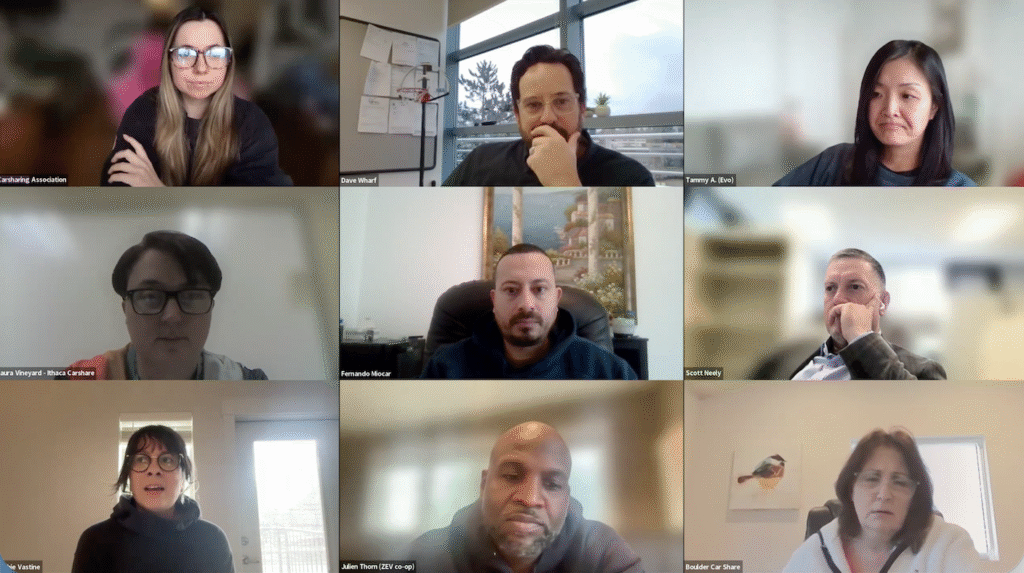
Key Takeaways: December 2025 CSO Member Chat
Every month, the Carsharing Association (CSA) brings Carshare Operators (CSOs) together for an informal, closed-door conversation focused on real-world challenges, lessons learned, and peer-to-peer knowledge sharing.
This most recent CSO chat welcomed both familiar voices and first-time attendees, with discussion spanning charging infrastructure vandalism, visibility trade-offs for garage-based vehicles, rising insurance costs, and the growing role of cameras and AI in fleet safety.
Below is a recap of the key themes and conversations.
Charging Cable Cutting & Infrastructure Vandalism
A major portion of the discussion focused on repeated EV charging cable theft and vandalism, particularly affecting smaller, nonprofit operators.
Key insights shared:
- Several operators are experiencing frequent cable cutting, often attributed to copper theft.
- Colorado CarShare reported multiple locations impacted simultaneously, resulting in vehicles being taken offline.
- Some vandalism occurs even in neighbourhoods with strong community relationships.
- Aftermarket resale of charging cables appears to be contributing to the issue.
Mitigation strategies discussed:
- Armoured / steel-reinforced charging cables, which have successfully prevented repeat incidents for ZEV Co-op.
- Temporarily deploying plug-in hybrids to keep vehicles operational when chargers are disabled.
- Reporting incidents via city QR codes and encouraging members to do the same to accelerate repairs.
Exploring media outreach to highlight the community impact of vandalism — particularly in low-income and senior-heavy neighbourhoods.
Community-Centred Messaging as a Deterrent
Several operators emphasized that how carshare is framed publicly matters.
Effective approaches included:
- On-site signage explaining that the vehicles are community-owned or nonprofit-operated, and that damage directly affects neighbours’ access to transportation.
- Messaging that quantifies impact (e.g. “Cutting this cable removes 20 rides for your community”).
- Differentiating nonprofit carshare clearly from large, corporate operators.
- Integrating community branding — such as using host site colours and visuals instead of carshare branding — to reinforce local ownership and trust.
Operators noted that strong community identification can reduce vandalism and increase informal “eyes on the street.”
Parking Garages vs Street Parking: Visibility Trade-Offs
The group discussed the pros and cons of relocating vehicles from street parking into parking garages or parcades, particularly in winter climates.
Challenges raised:
- Reduced visibility and spontaneous discovery, especially when vehicles are not visible from the street.
- Connectivity issues underground, including GPS and cellular signal challenges.
- Increased costs for wayfinding signage inside garages.
- Safety and accessibility concerns, especially for members navigating dark or isolated spaces.
- Risk of vehicles being moved by garage owners to less optimal locations.
Potential benefits:
- Reduced vehicle wear, sideswipes, and weather-related damage.
- Opportunities for Level 1 (slow) charging overnight.
- Better protection from vandalism in some contexts.
The consensus: garages can work for high-demand locations — but visibility, safety, and access must be carefully evaluated.
Insurance Pressures & Self-Insurance Models
Insurance remains one of the most pressing issues for CSOs.
Key points discussed:
- Rising premiums and very high deductibles (often $5,000+).
- Fewer insurers willing to cover nonprofit or shared mobility fleets.
- Some operators are exploring or adopting partial or full self-insurance models as fleets scale.
- Damage waiver programs remain important revenue streams, though balancing member uptake is challenging.
- Advanced vehicle technology (sensors, cameras, recalibration requirements) is driving up repair costs.
Operators agreed this topic warrants continued, deeper exploration.
Cameras, AI & Fleet Safety
The group also discussed in-vehicle camera systems and AI-enabled safety tools.
Insights shared:
- Some operators have installed inward- and outward-facing cameras at the request of insurers.
- AI features can detect:
- Seatbelt usage
- Distracted driving
- Smoking in vehicles
Obstructed cameras
- Real-world examples showed cameras prompting corrective behaviour before incidents occurred.
- Privacy concerns remain, requiring:
- Updated terms & conditions
- Proactive member communication
- Market-by-market consideration of legal frameworks
While adoption varies by jurisdiction, interest in these tools is growing — especially where insurers incentivize them.